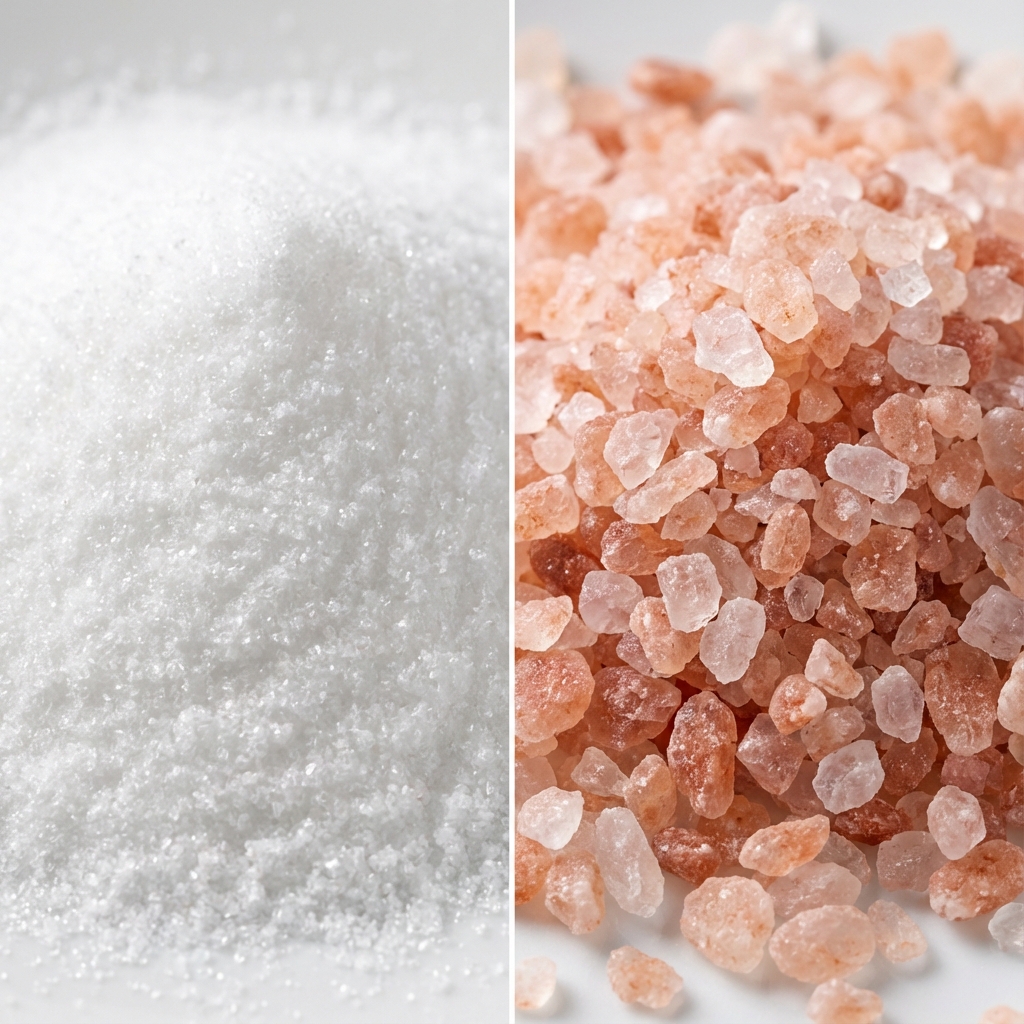
For decades, health organizations have waged a war against sodium. We have been told to put down the salt shaker, banish the savory seasoning from our dinner tables, and opt for "low-sodium" everything to protect our hearts and waistlines. But as nutritional science advances, a more nuanced truth is emerging: not all salt is created equal. The white, free-flowing powder in standard restaurant shakers is chemically distinct from the coarse, rose-hued crystals mined from ancient sea beds.
"Salt is not the enemy. Processed, chemically-stripped sodium is the enemy. Your body needs minerals to survive."
The debate between Himalayan Pink Salt and common Table Salt is often dismissed as a trend of culinary aesthetics, but the differences run deep—down to the molecular level, mineral density, and processing methods that fundamentally alter how your body metabolizes them.
Section 1: The Origin Story
To understand the nutritional divergence, we must look at the source. Himalayan Pink Salt consists of fossilized sea salt, harvested primarily from the Khewra Salt Mine in Pakistan. These salt deposits are remnants of ancient oceans that evaporated over 600 million years ago. Protected by lava and ice, they remained untouched by modern pollution.
In stark contrast, standard table salt is a manufactured product. It is often mined from underground deposits and then heated to 1,200°F. This heat alters the chemical structure. To make it flow freely, manufacturers add anti-caking agents like Sodium Aluminosilicate.
The "Table Salt" Reality Check
Did you know? Most table salt is 97.5% Sodium Chloride and 2.5% Chemicals/Sugar. Yes, sugar (dextrose) is often added to stabilize the iodine. If you are fasting, your table salt might be breaking your fast.
Section 2: The Mineral Matrix
The marketing claim is "84 minerals." While the amounts are trace, they act as a "synergistic package."
| Component | Himalayan Pink Salt | Table Salt |
|---|---|---|
| Source | Ancient Sea Beds (Pakistan) | Industrial Mines / Evaporated brine |
| Processing | Hand-mined, Stone-ground | Heated to 1200°F, Bleached |
| Additives | None (Pure Crystal) | Anti-caking agents, Dextrose |
| Mineral Profile | Calcium, Potassium, Magnesium, Iron | Sodium, Chloride, Iodine (added) |
| Taste | Subtle, Earthy, Complex | Sharp, Metallic, Salty |
Section 3: Fluid Dynamics & Bloating
One of the most immediate effects of switching salts is the reduction of water weight (bloating).
- Table Salt Effect: Because it is an unnatural isolation of sodium, the body struggles to eliminate it. It hoards water to dilute the sodium concentration in the blood. Result: Edema (swelling).
- Pink Salt Effect: The trace minerals (magnesium/potassium) help balance the cellular pumps. Water is drawn into the cell for energy, rather than staying outside the cell causing bloat.
Conclusion: A Small Shift
Switching your salt is likely the easiest health hack available. It requires no extra time, barely any extra money, and improves the taste of your food. By rejecting the bleached, industrial powder and embracing the raw, crushed crystal of the earth, you align your diet with biology.